
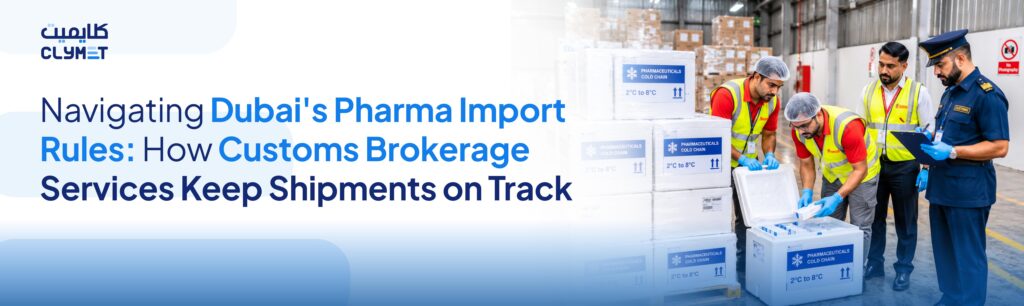
How can pharma imports clear Dubai Customs smoothly?
Accurate documentation, regulatory compliance and specialised customs coordination help prevent costly delays while protecting pharmaceutical shipments and maintaining cold-chain integrity.
Did you know that roughly 80% of the UAE’s pharma products are imported from overseas according to Pharma Boardroom? This data reveals the importance of pharmaceutical imports in the UAE, especially in Dubai. A shipment can cross thousands of kilometres without incident. But it encounters its biggest obstacle at the final customs checkpoint.
Reaching the border does not mean reaching the market. When a shipment of thermally sensitive medicines arrives on time but cannot secure regulatory clearance, it may affect the product integrity. As an international pharmaceutical trade hub, Dubai requires dependable customs brokerage services.
Considering the growing number of medicines, vaccines, biologics and temperature-controlled products being imported to Dubai, Clymet provides effective import brokerage services. The basis of our strategy is the fact that pharmaceutical imports require something more than ordinary freight forwarding.
Sometimes a single documentation discrepancy can hold up a consignment of critical medicines. In pharmaceutical logistics, a customs delay rarely remains confined to the customs desk. When precision is missing from paperwork, the entire cold chain faces the consequences.
What holds pharma shipments at customs?
Documentation discrepancies
Discrepancies within commercial invoices, packing lists and airway bills can have an impact on customs clearance. Documentation should be clear, stating descriptions of goods, their quantity, batch number and value. Failure in this will result in shipment delays.
Misclassification of HS codes
Active pharmaceutical ingredients, biologics and other medical products need to be properly classified for a seamless import/export process in pharma logistics. Incorrect classification can influence duty payments, regulations and inspection processes.
Incomplete regulatory authorisations
Import permits are crucial in customs clearance Dubai. Permits that are missing and importer licenses or registration certificates that are expired can affect the process. Additional approvals for controlled medicines, biological products and radioactive materials may also be required.
Inspection-related bottlenecks
Physical examination or regulatory verification plays an important role in customs clearance. Additional clarification requests from relevant authorities may be issued. Delays resulting from incomplete supporting information can slow down the entire process.
Cold chain vulnerabilities
In temperature controlled shipping, prolonged dwell time cannot be tolerated. Also, temperature excursions during inspection or cargo transfers can affect the product quality. So coordination between clearance and temperature-controlled storage must be adequate.
To prevent these bottlenecks, businesses must understand the regulatory framework governing pharmaceutical imports into Dubai.
Simplify your pharmaceutical imports with Clymet.
Call us today at 800-CLYMET or email info@clymet.ae.
The import of pharmaceuticals is done under a system whereby product safety is of higher priority than speed of delivery. Customs brokerage services in Dubai need to be consistent with the above mentioned system.
What are the important regulations?
Medicines and biopharmaceutical products require marketing authorisation from the EDE before import and distribution.
Pharmaceutical imports must be handled by an eligible, EDE-licensed pharmaceutical establishment.
Importers must obtain approval before shipment and apply for shipment clearance after receiving the shipping documents.
Required documents include commercial invoices, packing lists, airway bills and applicable batch certificates of analysis.
Products must retain at least two-thirds of their total shelf life upon arrival at UAE ports.
Pharmaceutical shipments must align with temperature-control requirements during transportation and handling.
Narcotic, controlled and semi-controlled medicines require specific import authorisation from the relevant regulatory authority.
Biological products may require batch-release certificates. Radioactive materials need permits from the Federal Authority for Nuclear Regulation (FANR).
Pharmaceutical shipments undergo regulatory inspections and require the necessary clearances before market distribution.
While these regulations establish the conditions for entry, their practical execution depends on how effectively documentation, customs procedures and cargo handling are coordinated.
Ensuring regulatory compliance begins long before a pharmaceutical shipment reaches Dubai’s customs checkpoint. The difference between a delayed consignment and a coordinated delivery often comes down to the expertise involved in managing the shipment’s journey.
Pharma imports demand a pharmaceutical logistics company that understands both the paperwork and the product. As a provider of customs brokerage services in Dubai, Clymet understands this and operates to fulfill this demand.
Dubai is the UAE’s largest pharmaceutical market, accounting for 39.7% of national market value in 2025 (Source: IMARC). The city handles different kinds of pharma imports daily. In this context, an organised approach for import brokerage is required.
Clymet focuses on:
Pre-arrival documentation coordination
Customs classification and clearance support
Integrated pharmaceutical cargo management
Cold chain continuity
End-to-end operational coordination
We help you verify commercial invoices, packing lists and shipping documents while ensuring accurate HS code classification. Customs clearance is part of our bigger pharmaceutical transportation process. Furthermore, validated logistics and packaging prevent the product from being exposed to any temperature excursions when transferring the cargo.
We know that good pharmaceutical imports aren’t only about getting through the customs process; it’s about keeping product integrity through the entire journey.
Simplify your pharmaceutical imports with Clymet.
Call us today at 800-CLYMET or email info@clymet.ae.
The common documents that may be needed for importing pharmaceutical products include invoices, packing lists, certificates of origin and product registration/import permits. However, depending on the type of medicine and its purpose, additional documents may also be needed.
Logistics brokerage is a systematic approach for handling the documentation and clearance of products as well as their transport. As regards the importation of pharmaceutical products, it may be helpful for the importer in this case.
Yes. Pharmaceutical importers need to comply with the Emirates Drug Establishment (EDE) requirements related to the concerned products and shipments.
The reasons could be wrong HS code classification, insufficient import licenses, inconsistencies in the shipping papers and absence of regulatory clearances as well as inspection requirements.
They will help the pharmaceutical company with logistics coordination, handling of paperwork, interaction with customs and delivery coordination. Partnering with a logistics company that is experienced in the pharmaceutical industry like Clymet, will benefit the business.
WhatsApp us