
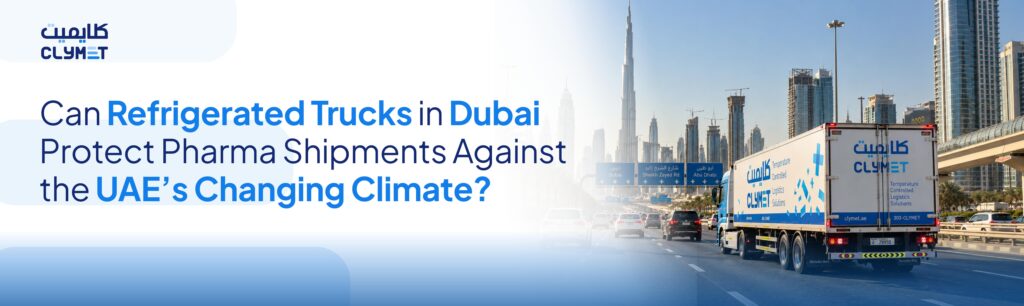
Can Dubai’s scorching heat outsmart a refrigerated truck?
When temperature rises and delivery delays mount, pharmaceutical integrity hangs in the balance. Explore how Clymet protects temperature-sensitive shipments through smarter cold chain safeguards.
Did you know that UAE’s highest reported temperature in 2026 so far is 51.2°C? (Source: Khaleej Times). When Dubai’s temperature rises pharmaceutical shipments face a challenge that extends far beyond the reach of conventional refrigeration. UAE’s summer heat and humid coastal conditions create a demanding environment for temperature-sensitive pharmaceutical distribution.
This is where businesses must think about whether refrigerated trucks in Dubai can protect the shipment against temperature exposure related to climate change. A refrigerated vehicle is a critical component of the cold chain. It maintains specified temperature conditions during road transportation between warehouses, distribution centers, airports and healthcare destinations.
But when the external environment becomes increasingly unforgiving, can it maintain product integrity without a wider system of safeguards?
Refrigerated trucks in Dubai may regulate the cargo compartment, but they cannot eliminate the environmental forces working against that system. 1.5–2 million kg of pharmaceutical cargo is moved every week on Emirates flights (Source:- The Emirates Group).
High ambient temperatures and direct solar radiation increase the thermal load on a vehicle’s insulated cargo body. They also lead to heat ingress, the transfer of external heat into a cooler compartment through walls, doors, seals and other vulnerable points. The refrigeration unit must remove this incoming heat while maintaining the shipment’s prescribed temperature. Some features prevent temperature excursions.
Insulated cargo body :- It slows external heat transfer.
Refrigeration unit :- It eliminates heat from the cargo compartment.
Door seals and thermal insulation :- Unwanted heat ingress can be reduced with this feature.
Pre-trip inspection :- Refrigeration performance, alarms, seals and equipment condition can be checked before loading.
Dubai’s coastal humidity and intense sunlight create additional environmental stress on pharmaceuticals logistics. While humidity affects certain products’ packaging or labels, temperature excursions occur when the product experiences temperatures outside its permitted limits.
Additionally, congestion, delayed deliveries, prolonged loading bay waits and repeated door openings increase exposure to external heat.
Why do refrigerated vehicles need more than cooling capacity?
Just cooling capacity may not be sufficient to ensure product integrity in refrigerated transport. Documented evidence that a vehicle can maintain the required conditions under defined operating circumstances is equally important. Also, it must have the capability to assess temperature distribution across different areas of the cargo compartment to identify potential hot and cold spots.
Moreover, calibrated sensors, appropriate sensor placement, door opening procedures and preventive maintenance must operate accordingly.
Keep every pharma shipment temperature-safe with Clymet
Call us today at 800-CLYMET or drop an email to info@clymet.ae.
The UAE cold chain market reached an estimated value of USD 0.68 billion in 2024. It is expected to reach USD 1.14 billion by 2030 (Source: Markntel Advisor). A shipment can arrive on schedule and still fail its most important test:- preserving the quality of the medicine it carries.
A temperature excursion is the exposure beyond the product’s specified temperature limits whether above or below the permitted range. There can be several consequences as a result.
Heat sensitive medicines could be degraded through a faster than normal chemical reaction.
Some biologics and vaccines could be unstable due to the loss of potency or stability.
Sometimes, freezing temperatures could affect some refrigerated medicines outside the recommended temperature range.
Temperature fluctuation may present some hazards depending on the product.
Proper action must be taken when a suspected excursion occurs. The logistics team must flag the deviation and review temperature records. They can quarantine or place the affected shipment on hold where appropriate. Teams must assess the excursion against manufacturer’s stability data and quality procedures.
Cold chain temperature monitoring becomes a mechanism for recording and assessing temperature conditions throughout transport. It includes relevant technologies such as:
Calibrated digital temperature sensors and data loggers
Continuous or appropriately configured interval-based recording
GPS-enabled shipment visibility linked with temperature records
Configurable high and low temperature alarms
Electronic records and excursion reports for traceability
The important factor is that monitoring identifies deviations, but it does not itself prevent them. So alerts must connect to defined escalation and corrective action procedures.
Reliable pharmaceutical distribution in changing climates depends on all systems working together, not just one piece of equipment.
Clymet designs pharmaceutical logistics services that match transport arrangements to each product’s temperature requirements, shipment duration and handling risks. The selection of appropriately qualified refrigerated trucks in Dubai is the first step. It is crucial to confirm that the vehicle can maintain the required operating range under anticipated ambient conditions.
Our team pre-conditions the cargo compartment before loading while inspecting refrigeration equipment and door seals. Needed precautions will be taken while planning delivery routes to minimise unnecessary stops.
Our approach includes validated thermal packaging, cold chain temperature monitoring, shipment visibility, contingency planning and documented handling. WHO route-profiling guidance recommends measuring route ambient temperature every 10–30 minutes. That is how we have structured our monitoring procedures.
Choosing a pharmaceutical logistics company involves more than comparing vehicle availability or delivery speed. Product-specific handling, documented procedures, equipment qualification, maintenance, trained personnel and coordinated escalation are equally important. Clymet bridges this gap by playing a wider role in pharmaceutical and life sciences logistics.
Dubai’s climate places greater demands on temperature-sensitive distribution. In this context, our reefer trucks act as the first line of defense that connects the complete procedures in cold chain transportation.
Keep every pharma shipment temperature-safe with Clymet
Call us today at 800-CLYMET or drop an email to info@clymet.ae.
The temperature ranges required by each medicine are ensured by using insulated cargo compartments and refrigeration units. This is made possible through pre-trip checks, proper qualification of vehicles and regular temperature monitoring.
Certainly. Excessive heat, strong radiation from the sun and high levels of humidity along the coast will make it difficult to transport pharmaceutical products through refrigeration and other means. The road traffic problem in Dubai makes it more challenging.
Temperature excursions occur when the temperatures fall outside the limits set for the particular product. This will depend on the type of medicine as well as the level of exposure to temperature excursions since this could lead to instability. It must be evaluated using the information from the manufacturer’s stability studies.
The process of cold chain temperature monitoring will ensure that there is documentation regarding the temperatures during the transit process. The use of calibrated sensors, data loggers and alarms can be significant.
Absolutely not. The use of reefer trucks alone will provide active temperature control. For a package to be reliably protected, it is essential that vehicles be qualified, good insulation is done, proper thermal packing is achieved among other things.
WhatsApp us